How IPAY Works
From checkout to parcel release in one controlled flow.
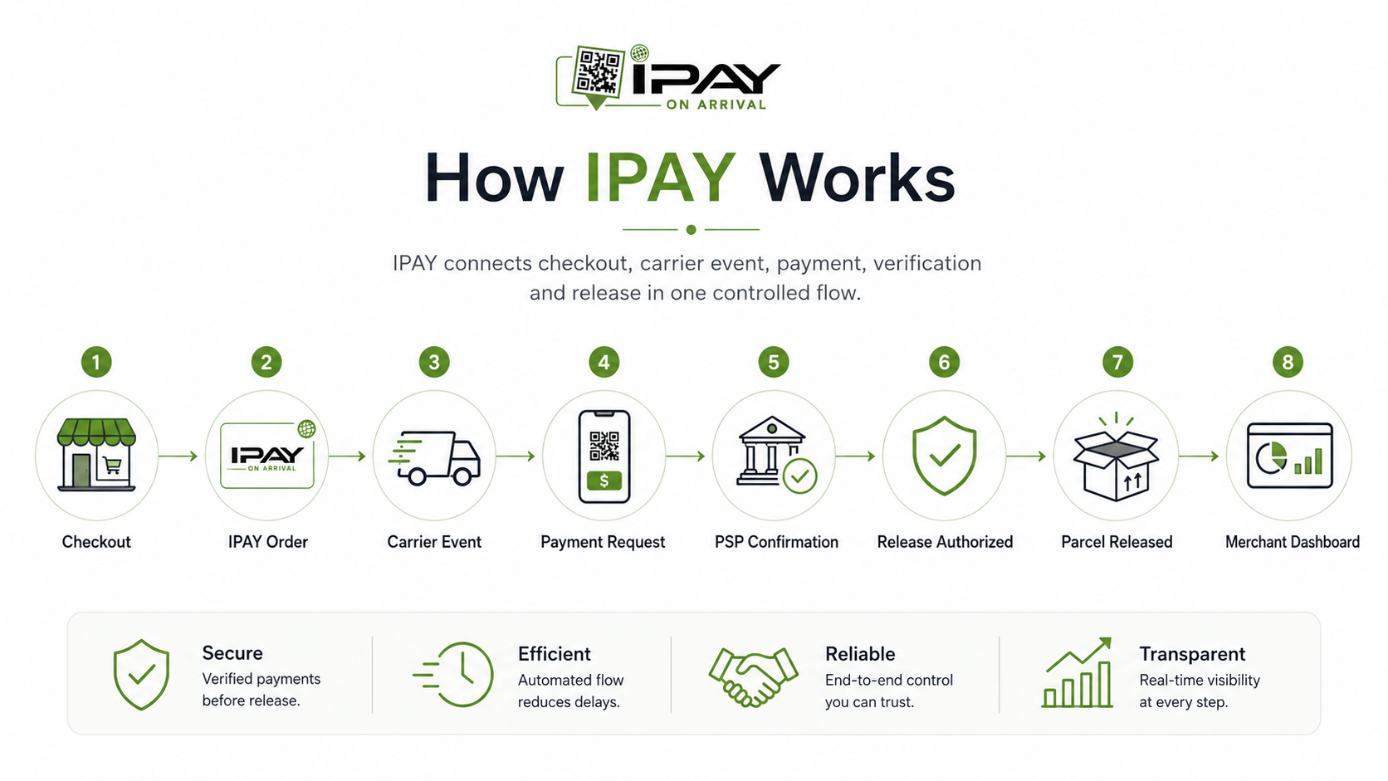
IPAY connects checkout intent, carrier events, payment confirmation, verification and release authorization.
The 8-step flow
One auditable sequence between merchant, carrier, PSP and consumer.
- 1
Checkout
The consumer selects IPAY or an IPAY-enabled payment option at checkout.
- 2
IPAY Order
The merchant, webshop, marketplace, WMS, 3PL or shipping tool creates the IPAY order.
- 3
Carrier Event
The carrier receives an IPAY-enabled delivery, pickup or locker release instruction.
- 4
Payment Request
The consumer receives a QR, payment link, app notification or wallet request.
- 5
PSP Confirmation
The PSP processes and confirms the payment. IPAY receives the payment status.
- 6
Release Authorized
IPAY validates the order and sends release authorization after successful payment confirmation.
- 7
Parcel Released
The carrier, pickup point or locker system releases the parcel.
- 8
Merchant Dashboard
The merchant receives real-time status, settlement references and reporting insights.
By design
IPAY does not need to hold funds.
IPAY coordinates the order, payment status, release authorization and reporting between merchant, carrier, PSP and consumer — funds are processed by licensed PSPs.
See the full API flow.
Test in sandbox, plug into your existing stack and go live with carrier-controlled release.