Payment Partners
Bring Pay On Arrival into PSPs, wallets and local payment rails.
IPAY creates last-mile payment moments at delivery, pickup, locker release, duties payment and return resolution. Payment partners process the payment; IPAY orchestrates the payment intent, release authorization and reporting layer.
You process the payment. IPAY orchestrates the order, payment intent, carrier release and reporting.
IPAY does not hold funds, does not replace PSPs and does not act as an acquirer. Payments are processed by licensed PSPs, wallets, acquirers or local payment partners.
Not a PSP competitor
IPAY extends PSP volume beyond checkout.
Most PSP payment volume happens at checkout. IPAY creates additional payment moments later in the commerce journey: at delivery, pickup, locker release, duties clearance and return resolution. IPAY does not compete with PSPs, wallets or local payment rails. IPAY routes payment intent to the selected payment partner and waits for confirmed payment status before carrier-controlled release.
- No funds held by IPAY
- Payments processed by licensed payment partners
- PSP confirmation triggers release authorization
- Works with wallets, cards, bank transfers and QR methods
- Adds new payment volume beyond checkout
- Supports merchant-owned customer relationships
- Enables reporting across merchant, PSP and carrier events
Why PSPs add IPAY
A new payment moment for PSPs.
Convert cash into digital volume
Digitize COD and delayed-payment flows into PSP-processed transactions.
Keep the PSP relationship in the flow
When IPAY is offered as a payment option through a PSP, the PSP remains the payment processor. IPAY adds the last-mile intent, release logic and reporting layer around the transaction.
Local method adoption
Bring local wallets, QR schemes and instant-payment rails into delivery, pickup and locker flows.
Carrier-confirmed use case
Payment confirmation is connected to carrier release, making the payment operationally meaningful.
No funds held by IPAY
IPAY does not act as a bank, lender, acquirer or card processor.
App and QR payment activation
Consumers can complete payments through the IPAY app, QR, payment link or mobile web — while the payment remains PSP-processed.
Reporting and reconciliation
Event-level reporting across merchant, PSP, carrier, release and settlement status.
Checkout placement
Add Pay On Arrival as a payment option — without turning it into prepaid checkout.
IPAY can be shown by PSPs, webshop platforms and merchants as a payment option for eligible orders. The customer selects Pay On Arrival during checkout, but the actual payment happens at the delivery, pickup, locker release or duties moment. The PSP processes the payment through the selected payment method. IPAY receives the confirmed payment status and authorizes the carrier release event.
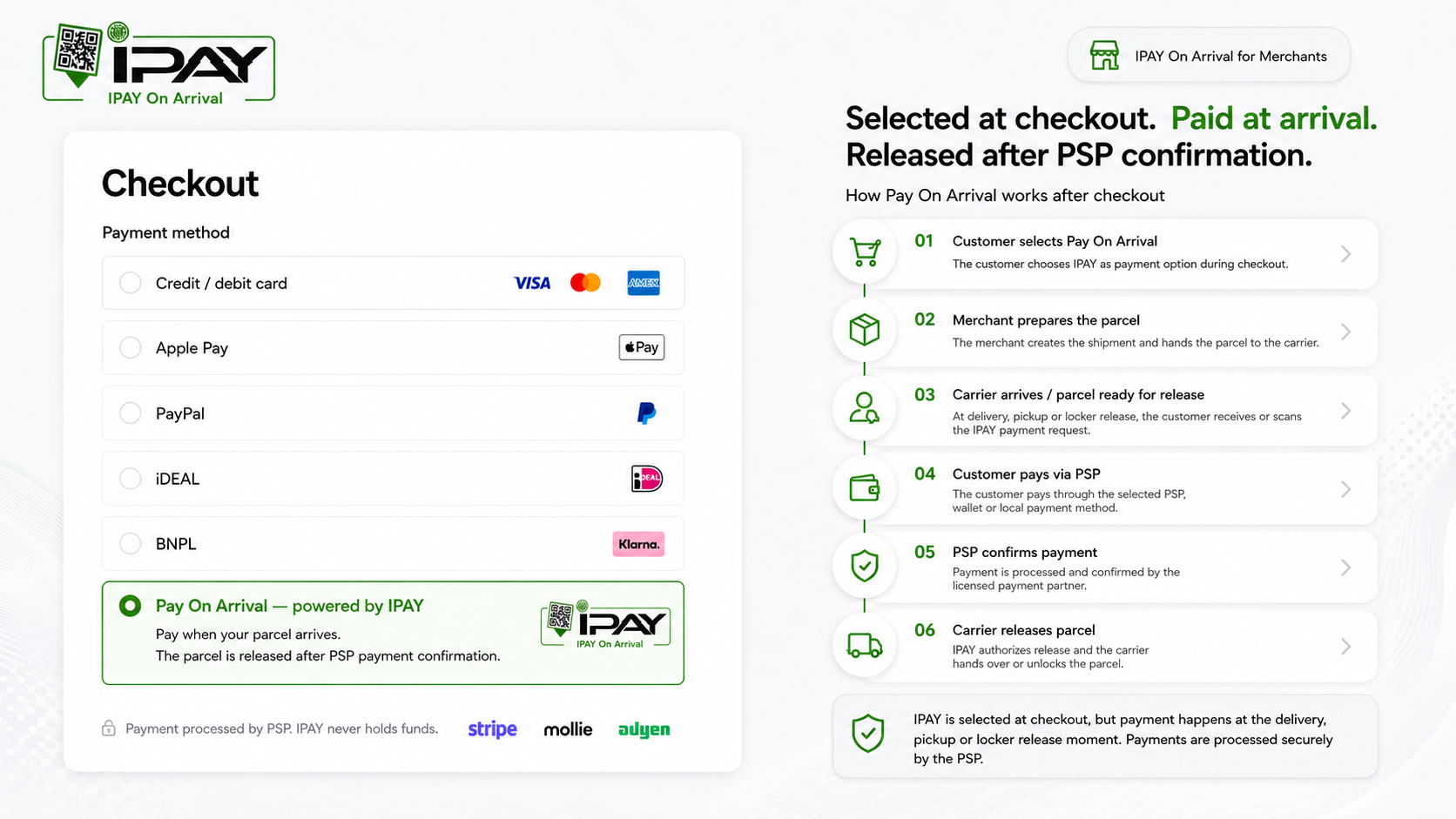
How Pay On Arrival works after checkout
- 01Customer selects Pay On Arrival
The customer chooses IPAY as payment option during checkout.
- 02Merchant prepares the parcel
The merchant creates the shipment and hands the parcel to the carrier.
- 03Carrier arrives / parcel ready for release
At delivery, pickup or locker release, the customer receives or scans the IPAY payment request.
- 04Customer pays via PSP
The customer pays through the selected PSP, wallet or local payment method.
- 05PSP confirms payment
Payment is processed and confirmed by the licensed payment partner.
- 06Carrier releases parcel
IPAY authorizes release and the carrier hands over or unlocks the parcel.
Checkout selects the option. The app can complete the payment. A customer may select Pay On Arrival at checkout and later complete the PSP-processed payment through the IPAY app, a QR scan, a payment link or mobile web flow.
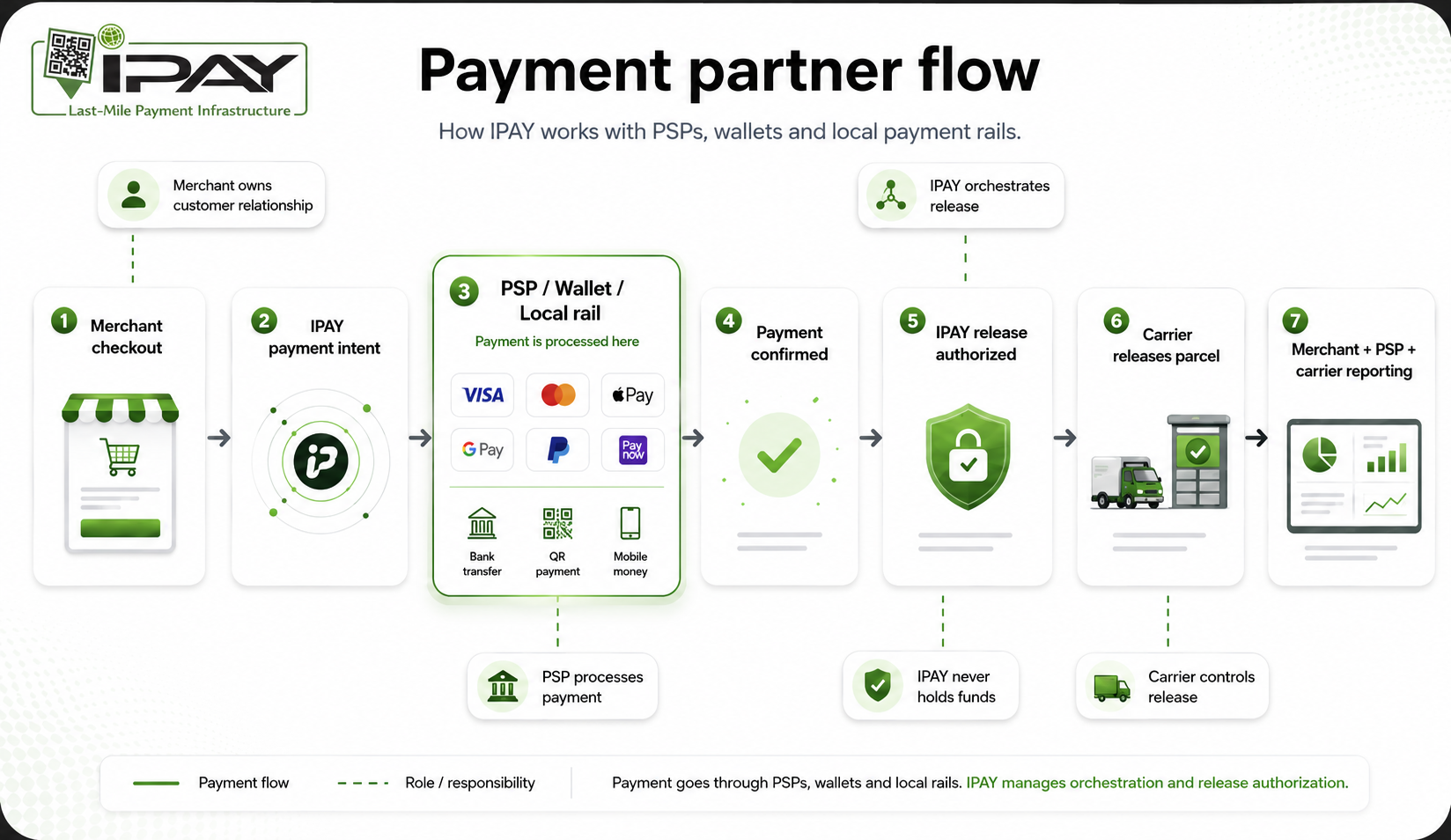
Payment partner flow
Where IPAY sits between checkout and delivery.
Merchant checkout → IPAY payment intent → PSP / Wallet / Local rail → Payment confirmed → IPAY release authorized → Carrier releases parcel → Merchant + PSP + carrier reporting.
- PSP processes the payment
- IPAY orchestrates the release
- Carrier controls the release
- Merchant owns the customer relationship
- IPAY never holds funds
Consumer app
The IPAY app creates more ways to complete PSP-processed payments.
The IPAY app gives consumers one place to view IPAY orders, receive payment requests, scan at delivery, manage Smart Returns, receive locker release information and use wallet-related features where available. The app does not replace the PSP. Payments are processed through the selected PSP, wallet or local payment method. IPAY uses the app to trigger, guide and confirm the last-mile payment and release experience.
App payment requests
Consumers receive secure payment requests for delivery, pickup, locker release, duties or return-related flows.
Scan & pay at arrival
Consumers scan the IPAY QR code when the parcel is ready for release and pay through the available PSP method.
Locker release support
The app shows locker payment status and release information where supported by the carrier or locker network.
Smart Returns
Consumers start a return, receive merchant alternatives, choose wallet credit where available, or generate a return QR or label.
Wallet and refund features
Wallet, refund and transfer features depend on country, merchant configuration, verification and payment partner availability.
Better payment completion data
Payment partners see app-initiated payments, method usage, failed-payment reasons and release-confirmed transactions.
Wallet, refund and transfer features depend on country, merchant, verification and payment partner availability.
Local payment rails
Cards, wallets, QR and instant-payment rails.
IPAY routes payment intent to the payment methods already available through the PSP, wallet or local payment partner relationship. Availability depends on PSP coverage, country, merchant setup and partner integration.
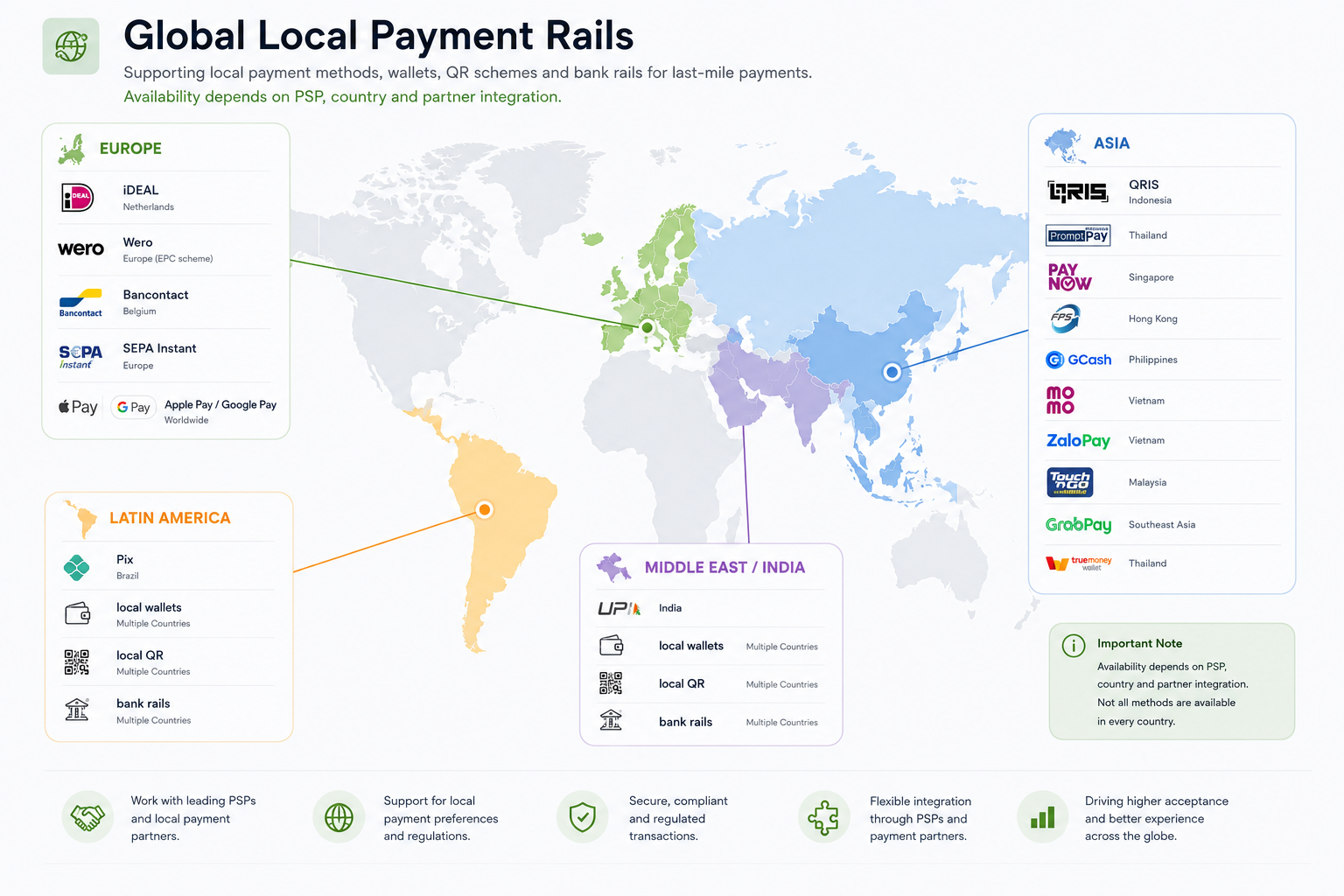
Europe
iDEAL · Wero · Bancontact · SEPA Instant · Apple Pay · Google Pay
Asia
QRIS · PromptPay · PayNow · FPS · GCash · MoMo · ZaloPay · GrabPay · TrueMoney
Middle East · India · LATAM (later)
UPI · Pix · local wallets · local QR · bank rails
Availability depends on PSP, wallet, country, merchant configuration and partner integration. IPAY does not guarantee availability of every method in every market.
Payment Partner Control Room
Your own control room — login via portal.ipay.global.
Every payment partner gets access to a dedicated Payment Partner Control Room. Your team can monitor payment volume, method activation, processing performance, app-initiated payments, release-confirmed transactions, settlement status and reconciliation exports. For PSPs and wallet partners, the control room shows how Pay On Arrival performs across countries, merchants, payment methods and delivery moments.
Request payment partner accessportal.ipay.global · login required
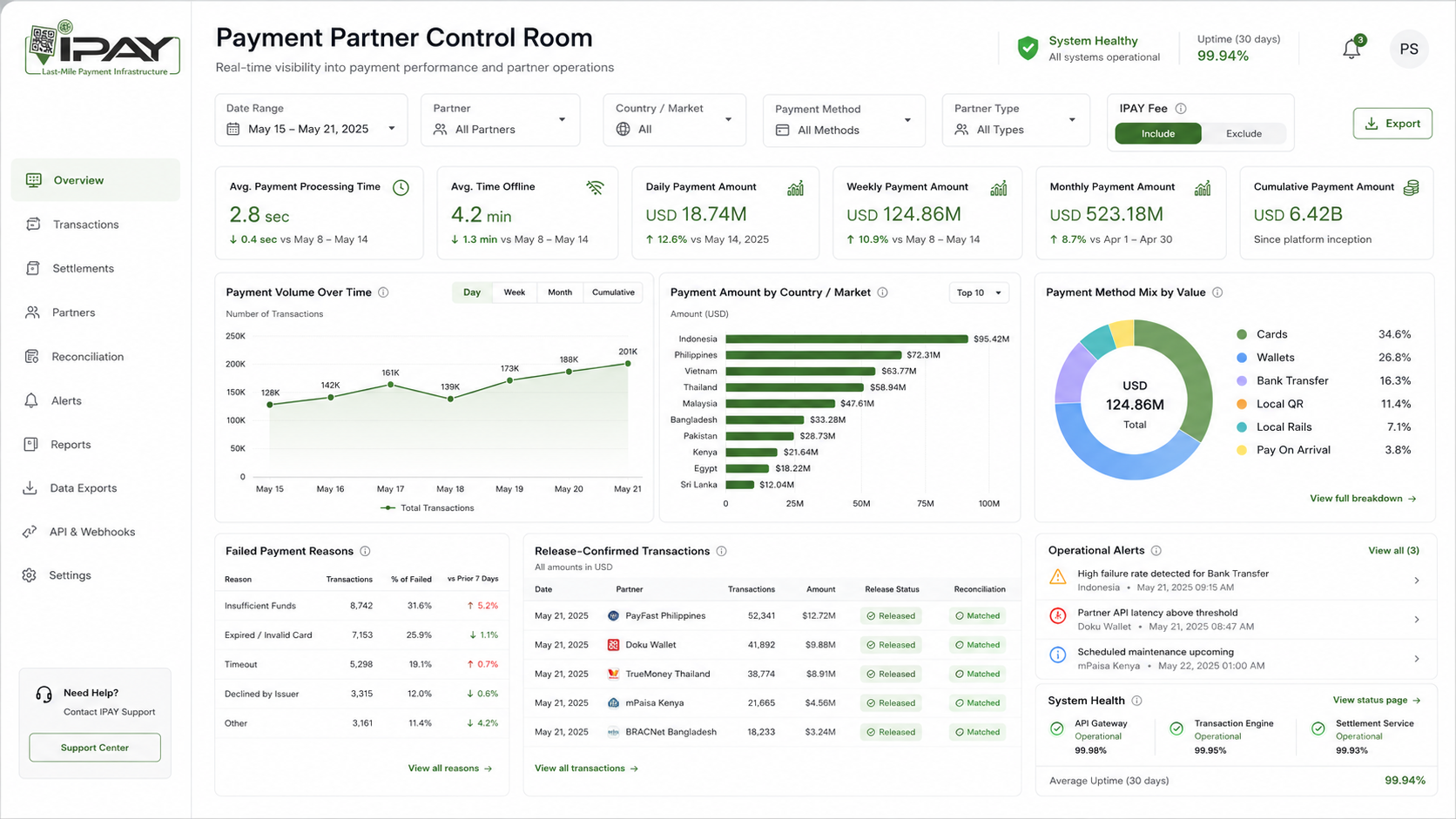
What lives inside the control room
Tariff agreements
Set and view commercial agreements per payment method, country, merchant or partner model.
Method activation
See which payment methods are enabled for IPAY and where they are exposed in checkout, app or payment-link flows.
Commercial fee configuration
Configure whether the IPAY orchestration fee is included, excluded or shown separately per merchant, method, country or agreement.
Daily settlement
Day-by-day settlement runs with transaction-level detail and reconciliation status.
Month-to-date
Current-month view with running totals, payment volume, fees, exceptions and trends.
Previous-month overview
Closed-month statement with full breakdown, ready for export to accounting or partner reporting.
Connected merchants
See which merchants are using your rails, in which countries and through which payment methods.
Activation & status
Onboarding status per merchant, contract status, technical integration health and method availability.
App & payment-link performance
Track app-initiated payments, QR scans, payment-link completion, failed reasons and release-confirmed transactions.
KPIs in the control room
- App-initiated payment volume
- Web payment volume
- QR scan conversion
- Payment request completion rate
- Wallet / local method usage
- Failed payment reasons
- Release-confirmed transactions
- Settlement export status
- App vs web payment split
- Average time from request to payment
- Average time from PSP confirmation to release authorization
Commercial model
Open partnership models — PSP-led processing.
IPAY creates incremental payment volume for PSPs, wallets and local payment partners. Commercial models can be agreed per PSP, country, payment method, merchant segment or distribution model. IPAY is open to partnership models for PSPs, wallets and local payment providers that support Pay On Arrival distribution, method activation, settlement reporting or checkout placement.
- PSP remains payment processor
- IPAY adds orchestration and release authorization
- Commercial models can differ by country, method and merchant segment
- Reporting available through Payment Partner Control Room
- Checkout, app and payment-link distribution supported
Add Pay On Arrival to your PSP, wallet or local-rail offering.
Talk to IPAY about payment method activation, checkout placement, country coverage, app payment flows, reconciliation exports and commercial partner models.